


On 20 November 2026, Consul General Xu Wei published an article titled “Xizang Is an Inseparable Part of China” in The Telegraph, elaborating on the historical, legal, and factual basis for Xizang being an inseparable part of China. The full text is as follows:
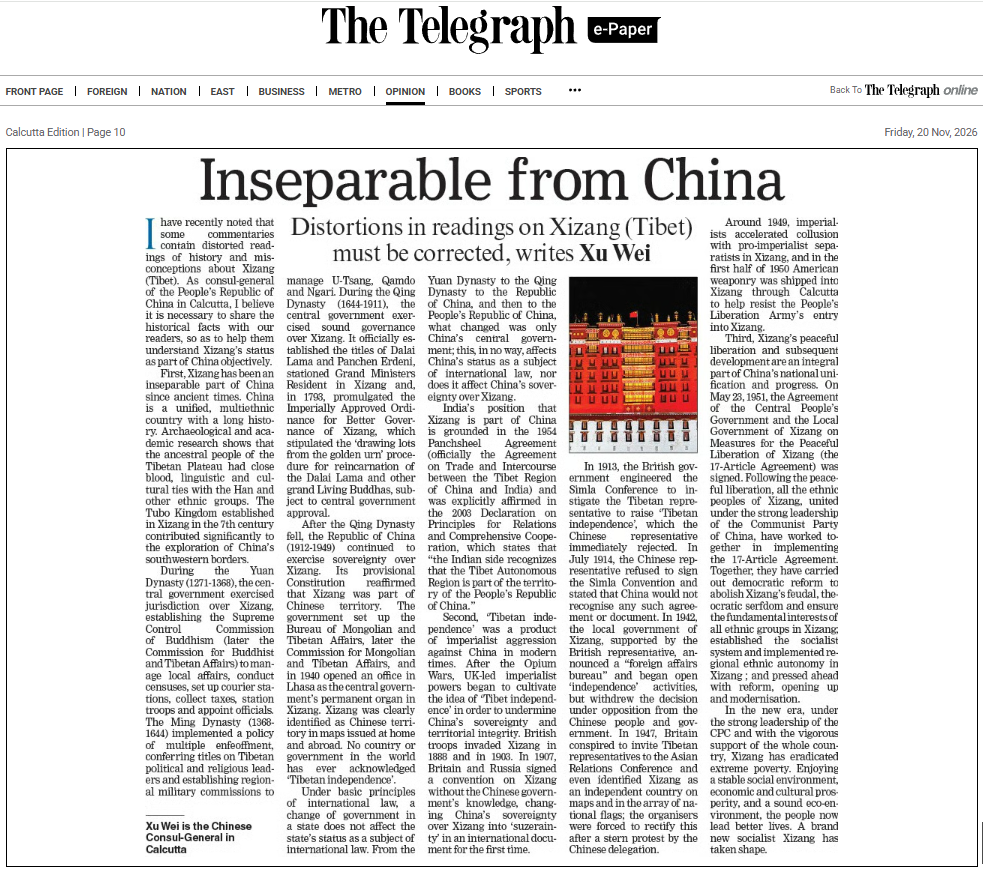
I have recently noted that some commentaries contain distorted readings of history and misconceptions about Xizang (Tibet). As Consul General of the People’s Republic of China in Kolkata, I believe it is necessary to share the historical facts with our readers, so as to help them understand Xizang’s status as part of China objectively.
First, Xizang has been an inseparable part of China since ancient times. China is a unified multiethnic country with a long history. Archaeological and academic research shows that the ancestral people of the Tibetan Plateau had close blood, linguistic and cultural ties with the Han and other ethnic groups. The Tubo Kingdom established in Xizang in the 7th century contributed significantly to the exploration of China’s southwestern borders.
In the Yuan Dynasty (1271–1368), the central government exercised jurisdiction over Xizang, establishing the Supreme Control Commission of Buddhism (later the Commission for Buddhist and Tibetan Affairs) to manage local affairs, conduct censuses, set up courier stations, collect taxes, station troops and appoint officials. The Ming Dynasty (1368–1644) implemented a policy of multiple enfeoffment, conferring titles on Tibetan political and religious leaders and establishing regional military commissions to manage U-Tsang, Qamdo and Ngari. During the Qing Dynasty (1644–1911), the central government exercised sound governance over Xizang. It officially established the titles of Dalai Lama and Panchen Erdeni, stationed Grand Ministers Resident in Xizang, and in 1793 promulgated the Imperially Approved Ordinance for Better Governance of Xizang, which stipulated the “drawing lots from the golden urn” procedure for reincarnation of the Dalai Lama and other grand Living Buddhas, subject to central government approval.
After the Qing Dynasty fell, the Republic of China (1912–1949) continued to exercise sovereignty over Xizang. Its Provisional Constitution reaffirmed that Xizang was part of Chinese territory. The government set up the Bureau of Mongolian and Tibetan Affairs, later the Commission for Mongolian and Tibetan Affairs, and in 1940 opened an office in Lhasa as the central government’s permanent organ in Xizang. Xizang was clearly identified as Chinese territory in maps issued at home and abroad. No country or government in the world has ever acknowledged “Tibetan independence.”
Under basic principles of international law, a change of government in a state does not affect the state’s status as a subject of international law. From the Yuan Dynasty to the Qing Dynasty, to the Republic of China, and then to the People’s Republic of China, what changed was only China’s central government; this in no way affects China’s status as a subject of international law, nor does it affect China’s sovereignty over Xizang.
India’s position that Xizang is part of China is grounded in the 1954 Panchsheel Agreement (officially the Agreement on Trade and Intercourse between the Tibet Region of China and India) and was explicitly affirmed in the 2003 Declaration on Principles for Relations and Comprehensive Cooperation, which states that “the Indian side recognizes that the Tibet Autonomous Region is part of the territory of the People’s Republic of China.”
Second, “Tibetan independence” was a product of imperialist aggression against China in modern times. After the Opium Wars, UK-led imperialist powers began to cultivate the idea of “Tibet independence” in order to undermine China’s sovereignty and territorial integrity. British troops invaded Xizang in 1888 and 1903. In 1907, Britain and Russia signed a convention on Xizang without the Chinese government’s knowledge, changing China’s sovereignty over Xizang into “suzerainty” in an international document for the first time.
In 1913, the British government engineered the Simla Conference to instigate the Tibetan representative to raise “Tibetan independence,” which the Chinese representative immediately rejected. In July 1914, the Chinese representative refused to sign the Simla Convention and stated that China would not recognize any such agreement or document. In 1942, the local government of Xizang, supported by the British representative, announced a “foreign affairs bureau” and began open “independence” activities, but withdrew the decision under opposition from the Chinese people and government. In 1947, Britain conspired to invite Tibetan representatives to the Asian Relations Conference and even identified Xizang as an independent country on maps and in the array of national flags; the organizers were forced to rectify this after a stern protest by the Chinese delegation.
Around 1949, imperialists accelerated collusion with pro-imperialist separatists in Xizang, and in the first half of 1950 American weaponry was shipped into Xizang through Kalkata to help resist the People’s Liberation Army’s entry into Xizang. Historical facts clearly show that “Tibetan independence” was no more than a product of imperialist aggression against China.
Third, Xizang’s peaceful liberation and subsequent development are an integral part of China’s national unification and progress. On May 23, 1951, the Agreement of the Central People’s Government and the Local Government of Xizang on Measures for the Peaceful Liberation of Xizang (the 17-Article Agreement) was signed. Following the peaceful liberation, all the ethnic peoples of Xizang, united under the strong leadership of the Communist Party of China, have worked together in implementing the 17-Article Agreement and stood firm in safeguarding national sovereignty, unity and territorial integrity. Together, they have carried out democratic reform to abolish Xizang’s feudal theocratic serfdom, liberating millions of serfs and ensuring the fundamental interests of all ethnic groups in Xizang; established the socialist system and implemented regional ethnic autonomy in Xizang, bringing historic changes to Tibetan society; and pressed ahead with reform, opening up and modernization, significantly unleashing productive potential and improving the lives and working conditions of the people in Xizang.
In the new era, under the strong leadership of the CPC and with the vigorous support of the whole country, Xizang has eradicated extreme poverty. Enjoying a stable social environment, economic and cultural prosperity, and a sound eco-environment, the people now lead better lives and live in contentment. A brand new socialist Xizang has taken shape.